

At Bella Rose Academy, we strive to:

At Bella Rose Academy, we strive to:

Provide exposure to a wide variety of information and literacy experiences, and the use of appropriate technology through daily activities in the environment and/or media center

Provide a safe environment designed for the developmental needs of the age group served and implemented with attention to the needs and differences of the individual children

Provide an active climate; one in which children interact with each other and with appropriate materials while engaging in cooperative hands-on learning related to the interests of the children

Provide a balance of activities including child-initiated and adult-directed. These activities may be active or quiet, performed individually, or in large and small groups

Infants (0 – 12 months)
$260

Toddlers (12 – 24 months )
$245

Twos (2 years old)
$215

Preschool (3 years old)
$215

Pre-Kindergarten (4 – 5 years old)
$150

Schoolage (6 years old and up)
$125 Before and After School
$90 Just Before or After School
$145 for Out of School, Spring & Summer Breaks, Christmas. Ect.

Annual Registration fee:

$150.00 for 1 child
$200.00 for 2 children
$250.00 for 3 or more children

Enrollment is based on a child’s space, not on attendance. Our detailed policy can be found in our Family Handbook.


Our Classes and Fees

adorable-baby-beautiful-bed-265987-4

Infants

  • The ability to think critically and creatively and understand their world.
  • To use the five senses to explore and observe.
  • To begin to copy the simple actions of others.
  • To perform actions to gain a response. The ability to think critically and creatively and understand their world.
  • To use the five senses to explore and observe.
  • To begin to copy the simple actions of others.
  • The ability to communicate effectively using sounds, expressions, body language, and finally, oral and written language; ability to understand and respond to the communication of others.
  • To learn to understand a variety of words by listening, observing, and engaging.
  • To use sounds and gestures to express needs, wants, and interests.
  • To listen to books read aloud.
  • The ability to coordinate and control large and small muscle movements; increasing awareness of health and safety concepts.
  • To work on physical milestones like rolling over and crawling.
  • Ttart to cooperate with care routines like getting dressed and washing hands.
  • Thow an interest in eating and trying new foods.
  • The ability to interact with others and their increasing awareness of themselves and their emotions; understanding of their relationships with others, such as family, friends, community members.
  • Torm an attachment to familiar adults.
  • Begin to interact with other children.
  • Build a sense of self by recognizing self in a mirror.
  • Begins to explore bright, contrasting colors.
  • Explore a variety of textures 
  • Listen to music and experiment with toy instruments.
adorable-baby-being-held-by-his-mother-sitting-floor2-pvhtegahzk0t2clccq42qh3syi0rb0wq05peq0htoo.jpg

Toddlers

  • Show interest in counting and start to identify objects.
  • Learn words like up and down and differences in size and volume.
  • Sort and classify objects 
  • Explore cause and effect
  • Use one or two words to label objects and express needs and wants.
  • Build an understanding of words through interactions including reading books.
  • Explore writing 
  • Learn to walk and start to run.
  • Play games that develop throwing and kicking skills
  • Show an increasing ability to control their hands
  • Start to communicate at mealtime using simple words
  • Show increased interest in interacting with familiar adults
  • Show increased interest in interacting with other children
  • Manage emotions independently or with the help of a familiar adult
  • Notice when other children are upset and try to help them feel better
  • Create art using materials like crayons and clay
  • Move creatively with other kids to learn body awareness and build social skills
  • Enter the world of make-believe with single props like puppets
  • Interact with music through games and simple songs
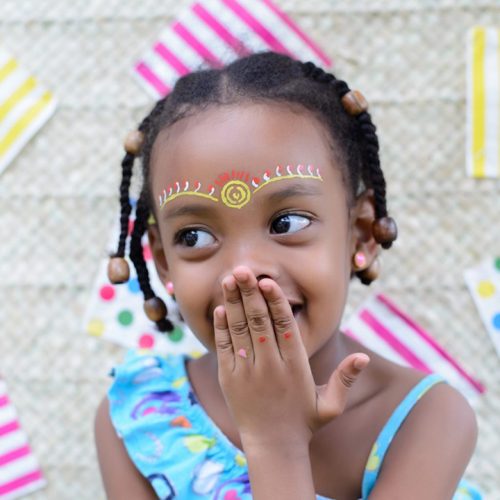
close-up-photo-of-smiling-girl-covering-mouth-1445465-1024x1024

Two's

  • Start to count, know numbers and basic shapes
  • Explore simple addition and subtraction using songs
  • Build science knowledge including the difference between day and night and different types of weather
  • Understand basic social studies like people’s roles within the community
  • Use a growing number of words to express needs and ideas
  • Learn the difference between similar-sounding words with rhyming games
  • Ask and answer simple questions about stories in books
  • Start to understand that drawing and writing are ways to communicate
  • Improve running skills and start to jump and hop
  • Understand and follow basic health and safety routines
  • Show increased control of hands and fingers
  • Interact with new people and feel comfortable playing near them
  • Share with other children and take turns
  • Build an appreciation for diversity 
  • Complete activities with confidence and look for new challenges
  • Experiment with different art materials to create artwork
  • Use creative movement to demonstrate feelings
  • Explore during imaginary play
  • Begin to use music to express feelings
adorable-blur-bookcase-books-261895

Preschool

  • Connect number words and numerals to the quantities they represent
  • Engage in pretend play alone or with others by taking on roles and using props
  • Participate in scientific experiments led by adults
  • Understand history by discussing changes to the community
  • Engage in longer conversations with adults and other children using a greater variety of words
  • Begin to identify the first sound in a word
  • Identify and name five to ten letters and begin to know sounds for some
  • Recognize his or her own name and begin to write it using both letters and letter
  • Like shapes
  • Begin to gallop while improving jumping and hopping skills
  • Trace letters and simple shapes while also showing signs of a right- or left-hand preference
  • Gain independence with self-care skills such as undressing to use the toilet and remembering to wash hands Identify healthy and unhealthy foods
  • Build relationships with familiar adults, talking about thoughts and needs with them
  • Seek out other children during playtime and begin to build relationships with them
  • Play with other children showing the ability to resolve disagreements with little help from adults
  • Express a variety of emotions by incorporating emotions into pretend play
  •  Create detailed artwork that includes people, animals, and things
  • Play movement games that involve following directions as well as creating unique moves
  • Play a character role in simple dramatic scenarios from books
  • Repeat more complex melodies and rhythm patterns
fun-kid-green-background1-pvhsmlcpfbvuyf2616l5c06z4dc45zb4i9mbnrsw3s.jpg

Pre-Kindergarten

  • Create simple patterns and arrange objects according to size
  • Perform simple addition and subtraction
  • Use knowledge and personal experiences to predict outcomes of scientific experiments
  • Explore a variety of cultures by identifying ways people are alike and different
  • Describe familiar people, places, things, and events with detail
  • Retell a familiar story with the beginning, middle, and end in order
  • Write his or her name as well as many other letters
  • Use writing as a way to describe experiences or feelings, making drawings and letters
  • Coordinate different body movements to catch and throw a ball and move through obstacle courses
  • Participate in physical activity for at least 2 hours daily
  • Use scissors to cut simple shapes and writing utensils to trace letters and numbers with greater accuracy
  • Discuss how exercise makes the body feel
  • Seek out interactions with a variety of adults, with both new and familiar people
  • Routinely share, take turns, and interact with other children in a respectful and helpful manner
  • Recognize and accept similarities and differences among people and showing an appreciation for diversity
  • Demonstrate an ability to resolve conflicts using words
  • Create detailed works of art using various materials like paint and modeling clay
  • Move to a temp, beat, or style of music
  • Follow multi-step directions as stated in a song, like hopping or clapping -participate in a variety of musical experiences
child-holding-plasticine-studio1-pvhsmo67ztzpx8y2kpt11hhcwiy7t2mbinks3lopl4.jpg

School-Age

Our before and after school program allows working parents the ability to have a safe, engaging, environment for their children. We provide transportation drop off and pick up to several local schools in the Moore school district.

We offer a variety of games, STEM projects, creative arts, and plenty of playtimes to keep kids happy and healthy. Our out-of-school camp is set up to provide school-age children with a safe, fun environment for a variety of games, STEM projects, creative arts, and field trips to local attractions and parks.